

This week has been an adventure in laundry. We suspected that our front-loading washing machine is also a dryer, so S took the owner's manual (all in Japanese, most in kanji) to the university for some translating help from his teaching assistants. The good news is that it is a dryer (the bad news is that it takes about as long as hanging the diapers on the balcony, which we'll continue to do).
In attempting to operate the dryer, I somehow activated the child safety lock on the door. One of the few things on the washer/dryer that I can read is the katakana for "door-locked." This blinking red light mocked me for two days as I pushed various buttons which caused my clothes to be washed three times and dried once, but did not cause the door to unlock.
My clothes were finally liberated today. We have to pay the rent in person (in cash!) at the real estate office, and today happened to be the day. S took the manual and was able to find a nice person (who is still no doubt laughing at us) to explain to him how to deactivate the child safety lock so that he could explain it to me via cell phone.
In this instance, I rather wish I was totally illiterate. I didn't know enough kanji to read the instructions in the manual, but I did know enough katakana to read that dumb "door-locked" light everytime I walked by.
Friday, April 17, 2009

Wednesday, April 15, 2009
Ja mata, Ojiisan. Arigatou gozaimasu, Obaasan.

We said goodbye to J's Grandpa and Grandma on Monday. We didn't like to see them go, but we're happy they made it back to California, and we were so glad they were able to be here. It was especially nice since they'd lived in Japan for a semester a couple of times, so they were able to orient us to some things. Though we've traveled a lot in Japan, we haven't had to do things like figure out which of the vast array of curry packages at the supermarket are vegetarian and what convenience stores are most likely to have the Japan Times.
J seemed a little out of sorts for a couple of days, which makes sense since Grandma stayed with us for over a month while S was already in Japan. When she suggested before J was born that she might do this, I thought it sounded like a nice idea. When she was here, it quickly became clear that J and I couldn't have functioned without her. S and I have spent a lot of time playing with the baby the last couple of days, though, and he seems to be adjusting. Hooray for extended family and airplanes!
So, we're back to talking to Ojiisan and Obaasan on the computer, which isn't the same as having them here, but J thinks is pretty cool nonetheless.
The picture, by the way, was taken at our neighborhood Shinto shrine.
Literacy
I know what it’s like to be illiterate. Here, I am illiterate. I look at billboards and have no clue what they’re advertising (which, come to think of it, isn’t so bad). Japan has three written languages: kanji (thousands and thousands of Chinese characters), hiragana (a simpler phonetic alphabet for Japanese words), and katakana (a phonetic alphabet for foreign words). I’ll never be much good at kanji, though I appreciate learning new characters and their roots as much as possible. My hiragana is a bit rusty, and I’ve never bothered much with remembering katakana (which is dumb, since I would normally actually know those words if I could read them clearly). I had big plans to brush up on my reading skills in the past few months, but the baby had other plans for me!
It turns out that grocery shopping takes a long time if you can’t read (especially with a fussy baby in the stroller), and being fluent in both kana languages would be quite helpful. So, to prevent the friendly staff at my local suupaa from thinking of me as that crazy gaijin who keeps asking where the jamu (jam) and co-hi (coffee) are, I’m putting myself through kana bootcamp. Already I can identify where the “baby salon” (baby changing room) is and which is the correct tofu for making kitsune udon.
It turns out that grocery shopping takes a long time if you can’t read (especially with a fussy baby in the stroller), and being fluent in both kana languages would be quite helpful. So, to prevent the friendly staff at my local suupaa from thinking of me as that crazy gaijin who keeps asking where the jamu (jam) and co-hi (coffee) are, I’m putting myself through kana bootcamp. Already I can identify where the “baby salon” (baby changing room) is and which is the correct tofu for making kitsune udon.
Tuesday, April 14, 2009
Daigoji

As the last of the cherry blossoms started to fall, we watched a reenactment of a famous hanami party at Daigoji, a temple in southeastern Kyoto. Our friend K who is studying at Nagoya U. came along for the festivities and we enjoyed bento lunches u nder the blossoms and then watched traditional dancing and a procession of people potraying Toyotomi Hideyoshi and his court enjoying a 1598 party.
The centerpiece of Daigoji is a five storied pagoda dating from 951 (Kyoto's oldest building). The staff for the festival were wearing bright pink windbreakers which said "Daigoji. Since 874." I like this--it's like reading a sign on a diner in Vermont: "since 1978."

The down side of all this beautiful springtime is the pollen from the sugi trees (cryptomeria). Lots of smart folks are wearing face masks to prevent allergic reactions. I'm not, and so I'm suffering a little. Little J seems to have inherited my respiratory system--he's been sneezing and his poor little eyes are watering.
 nder the blossoms and then watched traditional dancing and a procession of people potraying Toyotomi Hideyoshi and his court enjoying a 1598 party.
The centerpiece of Daigoji is a five storied pagoda dating from 951 (Kyoto's oldest building). The staff for the festival were wearing bright pink windbreakers which said "Daigoji. Since 874." I like this--it's like reading a sign on a diner in Vermont: "since 1978."

The down side of all this beautiful springtime is the pollen from the sugi trees (cryptomeria). Lots of smart folks are wearing face masks to prevent allergic reactions. I'm not, and so I'm suffering a little. Little J seems to have inherited my respiratory system--he's been sneezing and his poor little eyes are watering.

We're saying a final farewell to the cherry blossom season today. After an entire week of fabulous weather, it's now windy and rainy. Sayanara sakura.
Sunday, April 12, 2009
Tetsugaku no michi
As part of our ongoing "hanami" experience, we rode the bus to the northern part of Higashiyama, the Eastern temple district of Kyoto. Here, after lunch in the Japanese equivalent of a diner, we strolled along the tetsugaku no michi, the "Philosopher's Path." This path along a canal is named for Nishida Kitaro, a famous member of the "Kyoto School" of philosophy. Nishida apparently took his daily constitutionals along this scenic path which separates the hills and temples from the bustle of the city. The canal is, of course, lined with cherries. Thus, it was also lined with hundreds of other sakura-watchers.
We ended our day with a hanami picnic on our own neighborhood river path (Takano-gawa). The local supermarket (in the basement of the local department store) has a nice selection of take out sushi, root vegetable salads, Japanese pickles, vegetable croquettes, and other picnic foods (such as chocolate croissants from the adjace nt French bakery). I see many picnics in our future. We're on the lookout for bento boxes--individual lunchboxes in which we can pack all our picnic goods. We'll never be short on drinks for our picnics--on just about every block, one can find machines dispensing everything from Georgia canned coffee (hot and cold--my favorite is Emerald Mountain Blend) to one-cup sake and Suntory "Straight" beer, which "cheers the mind."
 our ongoing "hanami" experience, we rode the bus to the northern part of Higashiyama, the Eastern temple district of Kyoto. Here, after lunch in the Japanese equivalent of a diner, we strolled along the tetsugaku no michi, the "Philosopher's Path." This path along a canal is named for Nishida Kitaro, a famous member of the "Kyoto School" of philosophy. Nishida apparently took his daily constitutionals along this scenic path which separates the hills and temples from the bustle of the city. The canal is, of course, lined with cherries. Thus, it was also lined with hundreds of other sakura-watchers.
We ended our day with a hanami picnic on our own neighborhood river path (Takano-gawa). The local supermarket (in the basement of the local department store) has a nice selection of take out sushi, root vegetable salads, Japanese pickles, vegetable croquettes, and other picnic foods (such as chocolate croissants from the adjace
 nt French bakery). I see many picnics in our future. We're on the lookout for bento boxes--individual lunchboxes in which we can pack all our picnic goods. We'll never be short on drinks for our picnics--on just about every block, one can find machines dispensing everything from Georgia canned coffee (hot and cold--my favorite is Emerald Mountain Blend) to one-cup sake and Suntory "Straight" beer, which "cheers the mind."
Thursday, April 9, 2009
Hanami
The last couple of days, we’ve been reliving scenes from Tanazaki Junichiro’s The Makioka Sisters, a novel about an old Osaka family in the twilight of its wealth and prestige (in a Japan experiencing the twilight of its traditional ways just prior to WWII). In the novel, the sisters, as do most Japanese, take part in “hanami,” or cherry blossom viewing. They visit certain famous sites in Kyoto each spring, including the Heian Shrine and Maruyama Park, where they appreciate a famous old weeping sakura in its own twilight years.
We also visited the Heian Shrine and Maruyama Park this week. The Heian Shrine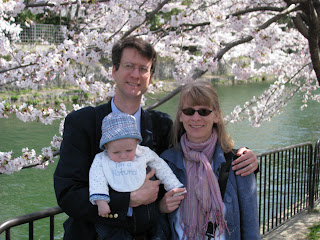 boasts a dazzling array of weeping cherries in an arbor area. There, the air itself almost seems pink. We enjoyed green tea ice cream in a resting spot near a pond, perhaps where Tanizaki’s fictional Makioka sisters would have rested to enjoy the blossoms floating by on the breeze.
We waited until evening to visit Maruyama Park with its famous weeping cherry. Tanizaki notes, pre-WWII, that this stately tree is already declining, though it’s still today the centerpiece of the park. The experience of evening hanami was quite an adventure. We were there with thousands of other blossom enthusiasts, many who had gone earlier in the day and tarped off pieces of ground for picnics under the illuminated branches. Surrounding the picnic area were 50-60 food vendors selling everything from barbequed mochi (I’m sure there’s a real name for this delicious treat) to takoyaki (fried octopus) to fish on a stick (note that this isn’t fishsticks—it’s actually small fish ON a stick, like a corn dog with eyes). I’m guessing there were many, many blearly-eyed and hungover Kyoto business people the next day. Cherry blossom viewing in Kyoto can be quite a circus!
As the blossoms start to fade and fall like snow, I’m reminded of Tanizaki’s passage about the Makioka sisters’ own hanami experience: "The cherries in the Heian Shrine were left to the last because they, of all the cherries in Kyoto, were the most beautiful. Now that the great cherry in Gion was dying and its blossoms were growing paler each year, what was left to stand for the Kyoto spring if not the cherries in the Heian Shrine? And so, coming back from the Western suburbs on the afternoon of the second day, and picking that moment of regret when the s pring sun was about to set, they would pause, a little tired, under the trailing branches, and look fondly at each tree--on the lake, by the approach to a bridge, by a bend in the path, under the eaves of the gallery. And, until the cherries came the following year, they would close their eyes and see again the color and line of a trailing branch."
 (in a Japan experiencing the twilight of its traditional ways just prior to WWII). In the novel, the sisters, as do most Japanese, take part in “hanami,” or cherry blossom viewing. They visit certain famous sites in Kyoto each spring, including the Heian Shrine and Maruyama Park, where they appreciate a famous old weeping sakura in its own twilight years.
We also visited the Heian Shrine and Maruyama Park this week. The Heian Shrine
 boasts a dazzling array of weeping cherries in an arbor area. There, the air itself almost seems pink. We enjoyed green tea ice cream in a resting spot near a pond, perhaps where Tanizaki’s fictional Makioka sisters would have rested to enjoy the blossoms floating by on the breeze.
We waited until evening to visit Maruyama Park with its famous weeping cherry. Tanizaki notes, pre-WWII, that this stately tree is already declining, though it’s still today the centerpiece of the park. The experience of evening hanami was quite an adventure. We were there with
 thousands of other blossom enthusiasts, many who had gone earlier in the day and tarped off pieces of ground for picnics under the illuminated branches. Surrounding the picnic area were 50-60 food vendors selling everything from barbequed mochi (I’m sure there’s a real name for this delicious treat) to takoyaki (fried octopus) to fish on a stick (note that this isn’t fishsticks—it’s actually small fish ON a stick, like a corn dog with eyes). I’m guessing there were many, many blearly-eyed and hungover Kyoto business people the next day. Cherry blossom viewing in Kyoto can be quite a circus!
As the blossoms start to fade and fall like snow, I’m reminded of Tanizaki’s passage about the Makioka sisters’ own hanami experience: "The cherries in the Heian Shrine were left to the last because they, of all the cherries in Kyoto, were the most beautiful. Now that the great cherry in Gion was dying and its blossoms were growing paler each year, what was left to stand for the Kyoto spring if not the cherries in the Heian Shrine? And so, coming back from the Western suburbs on the afternoon of the second day, and picking that moment of regret when the s
 pring sun was about to set, they would pause, a little tired, under the trailing branches, and look fondly at each tree--on the lake, by the approach to a bridge, by a bend in the path, under the eaves of the gallery. And, until the cherries came the following year, they would close their eyes and see again the color and line of a trailing branch."
Jetlag

After two days, four bad movies, and countless sleepless nights, Little J and I have finally joined S in Kyoto. Bless his little heart, J is a good traveler. He lounged and slept in his carseat for much of the two-day journey and made lots of friends along the way (stranger anxiety hasn’t hit yet). The transition to the 13-hour time difference is coming along, and we’re just about back to normal (which includes waking up a few times at night, but at least resembles a full night’s sleep since the sleeping and waking does happen at night rather than during the daytime!).
We’re now official—J and I visited the ward office to register as aliens and to be added to Japan’s national healthcare system.
J is enjoying a windfall of adults these days—his Grandma came on the plane with us, and his Grandpa arrived from California last night. Four adults per baby is just about right in our household!
Subscribe to:
Posts (Atom)